News

2026 Hydraulic Trailer Industry: Sustained Growth Driven by Technological Innovation

2026-04-25 0 Leave me a message

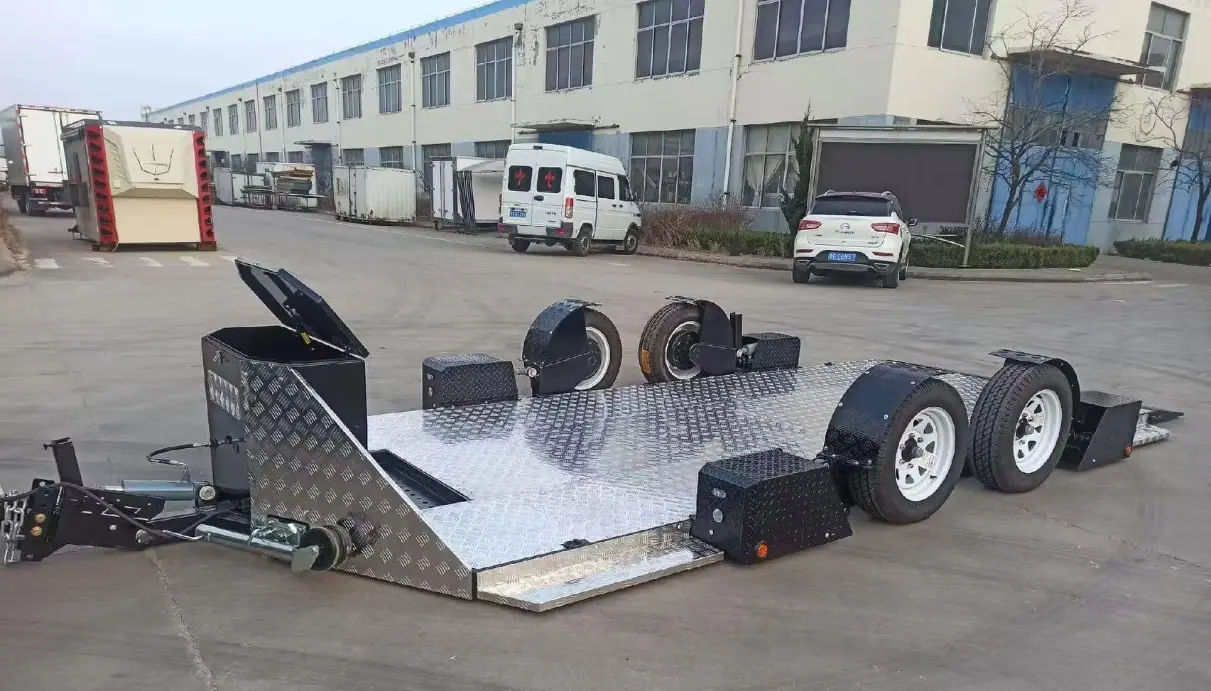
Since 2026, the global hydraulic trailer industry has entered a steady growth period, with the market scale continuing to expand, technological innovation accelerating, leading enterprises actively deploying global production capacity, and application scenarios constantly extending. From hydraulic lift trailers to hydraulic modular trailers, from traditional heavy-duty transportation to high-end precision equipment transfer, hydraulic trailers have become core equipment in engineering, maritime, agricultural, heavy-duty transportation and other fields, relying on their core advantages of high efficiency, safety and heavy load-bearing capacity. At the same time, the industry also presents distinct development trends of intelligence, lightweight and new energy, providing more valuable transportation solutions for global customers.


According to the latest industry report by QYResearch, the global hydraulic tail trailer market size reached 1.137 billion US dollars in 2025, and is expected to grow at a Compound Annual Growth Rate (CAGR) of 4.5% from 2026 to 2032, exceeding 1.541 billion US dollars by 2032. The hydraulic boat trailer market also performed brilliantly, with a market size of 622 million US dollars in 2025, a CAGR of 5.8%, and is expected to increase to 917 million US dollars by 2032, with a global output of 8,300 units in 2025. As a core segment, the global hydraulic dump trailer market size reached 12.48 billion US dollars in 2026, with a CAGR of 9.1% from 2026 to 2035, becoming the core driving force for industry growth. The Chinese market also performed prominently. In 2025, the market size of China's hydraulic multi-purpose transport vehicles reached 12 billion yuan, a year-on-year increase of 15.6%, the proportion of high-end intelligent products rose to 35%, the industry concentration continued to improve, and the CR5 increased from 38% to 52%, further highlighting the technological and production capacity advantages of leading enterprises.


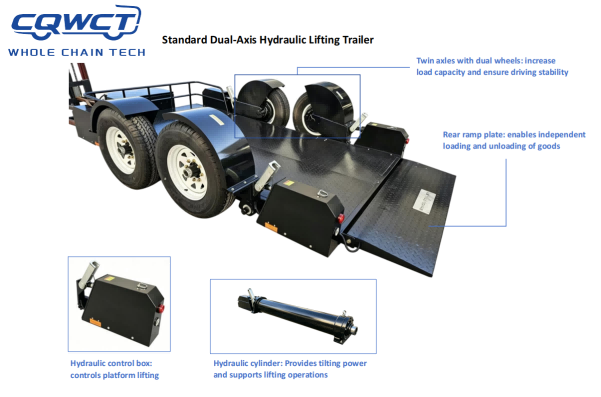
Technological innovation has become the core competitiveness of the hydraulic trailer industry in 2026, and a number of breakthroughs have brought more efficient, safer and more economical user experiences to customers . Lightweight technology has been widely applied. Leading enterprises have adopted carbon fiber leaf springs and composite material fuel tanks in 50-ton hydraulic cable reel trailers, reducing the overall vehicle weight by 18.4% (about 2.3 tons) and increasing the effective load by 15-20%, which greatly reduces customers' fuel consumption and operating costs. Electro-hydraulic integration technology has been rapidly popularized. In 2025, the market share of electro-hydraulic pumps reached 32%, and the energy consumption of Volvo e-Tipper was 41% lower than that of traditional diesel systems. The advantages of precise speed control and low noise reduce equipment wear, extend service life, and lower customers' maintenance costs. The intelligent hydraulic suspension system has been upgraded, which can real-time monitor axle load, pressure and levelness, automatically balance the load, reduce the risk of local overload by 70%, and extend the equipment life by more than 30%, helping customers reduce downtime and improve transportation efficiency. New energy technology has gradually been put into practice. Germany's ACV launched a hydrogen-powered hydraulic rescue trailer (4-ton class) to achieve zero emissions, adapt to the global "dual carbon" policy, help customers meet environmental compliance requirements, and reduce long-term operating costs. In addition, the hydraulic tilt/lift decks launched by Knob Hill and other enterprises can achieve a loading and unloading angle of 10-18 degrees, enabling direct ground loading and unloading without ramps, which greatly improves customers' loading and unloading efficiency and reduces labor and safety risks.


Leading enterprises are accelerating their global layout, further improving the supply chain, and providing customers with more convenient and efficient services. On April 15, 2026, Hyva, a subsidiary of JOST, put into operation a new 17,000-square-meter factory in Caxias do Sul, Brazil, with an annual production capacity of 52,000 hydraulic cylinders, 40,000 hydraulic kits and 1,500 mobile floor systems. Focusing on the agricultural, construction and off-road markets, it strengthens its layout in South America, shortens the delivery cycle for South American customers, and reduces logistics costs. On March 26, Metsjö launched the Metaq51 heavy-duty dump trailer, which adopts hydraulic suspension and lightweight design, with the advantages of high load-bearing capacity and low self-weight, optimizes the cargo box structure, makes unloading smoother and longer service life, and provides more durable and efficient heavy-duty transportation solutions for agricultural and engineering contractor customers. CIMC Vehicles launched the ZJY60 intelligent hydraulic dump truck, which adopts Q550D high-strength steel chassis and intelligent hydraulic linkage technology, and is applied in the expansion project of the Hong Kong-Zhuhai-Macao Bridge, transporting 3,200 tons of sand and gravel per day, helping customers improve engineering construction efficiency. In the global hydraulic modular trailer (SPMT/HMT) field, the top five manufacturers (TII, Goldhofer, Faymonville, Sinotruk, Dafang) account for more than 60% of the market share. The Asia-Pacific region has become the largest market (accounting for more than 45%), with Europe and North America each accounting for more than 20%. The global supply chain layout further improves the convenience of customer procurement and service response speed.


Application scenarios continue to expand, and the adaptability of hydraulic trailers is constantly improving to meet the personalized needs of customers in different industries. In the field of engineering and heavy-duty transportation, Islandview introduced McCauley hydraulic lowboy trailers, replacing traditional ramps with hydraulic lift decks, which increased loading and unloading efficiency by 50% and reduced safety risks by 60% in complex sites, adapting to the transportation of ultra-heavy equipment such as wind power, shield tunneling and transformers. In the maritime and boating field, hydraulic boat trailers have gradually replaced traditional hoisting methods, improving the utilization rate of dock space and reducing hull damage, adapting to scenarios such as ship manufacturing, yacht leisure and port terminals, and becoming core equipment for maritime transportation. In the agricultural and off-road fields, hydraulic dump trailers such as Metaq51 have become standard equipment for farms and engineering contractors, and their stability and durability advantages improve the transportation efficiency of agricultural materials and engineering materials. In the shale fracturing field, the market size reached 807 million US dollars in 2025, with a CAGR of 9.3%, and is expected to increase to 1.486 billion US dollars by 2032. Hydraulic trailers have become the core choice for shale fracturing equipment transportation due to their heavy load-bearing capacity. It is worth noting that the overall gross profit margin of the hydraulic boat trailer industry is at a medium to high level, with the gross profit margin of light and medium-sized standard hydraulic trailers being about 20%-30%, and that of heavy-duty self-propelled and highly customized equipment reaching 30%-45%. The core competitiveness focuses on structural design, hydraulic integration, customization efficiency, etc., which also provides customers with more cost-effective customized solutions.


Looking forward to 2026 and beyond, the hydraulic trailer industry will continue to show three major development trends: accelerated intelligent upgrading, with AI monitoring, remote control, automatic leveling and fault early warning becoming standard, further reducing the difficulty of customer operation and maintenance costs; in-depth integration of lightweight and new energy, combining high-end materials such as carbon fiber and aluminum alloy with electro-hydraulic and hydrogen energy drive technologies to achieve weight reduction, emission reduction and efficiency improvement, helping customers achieve green operations; prominent customized demand, enterprises will customize exclusive hydraulic systems and product structures according to customers' working conditions, load capacity and terrain needs to improve customer experience. At the same time, the industry also faces challenges such as trade barriers, cost pressure and the shortage of compound talents. Leading enterprises will continue to improve their core competitiveness through technological research and development, supply chain optimization and localized layout.


As core equipment in the modern transportation field, the technological innovation and market expansion of hydraulic trailers will continue to create value for customers in engineering, agriculture, maritime, heavy-duty transportation and other industries, helping customers improve transportation efficiency, reduce operating costs, ensure transportation safety, and promote the high-quality development of the global logistics and engineering transportation industry.

Related News
Leave me a message
X
We use cookies to offer you a better browsing experience, analyze site traffic and personalize content. By using this site, you agree to our use of cookies. Privacy Policy
Reject Accept