Whatsapp
The production starts with strict incoming material inspection for all Q355B structural steel (pipes and plates). Q355B is a low-alloy high-strength steel widely used in engineering and transportation equipment, with excellent yield strength (≥355MPa), good toughness, and weldability—perfect for trailer frames and load-bearing components.
Inspectors verify:
• Material certificate consistency (chemical composition: C, Si, Mn, P, S, etc.)
• Mechanical properties (tensile strength, yield strength, impact resistance at 20℃)
• Dimensional accuracy (thickness, diameter, flatness)
• Surface quality (no cracks, rust, or oxide scale defects)
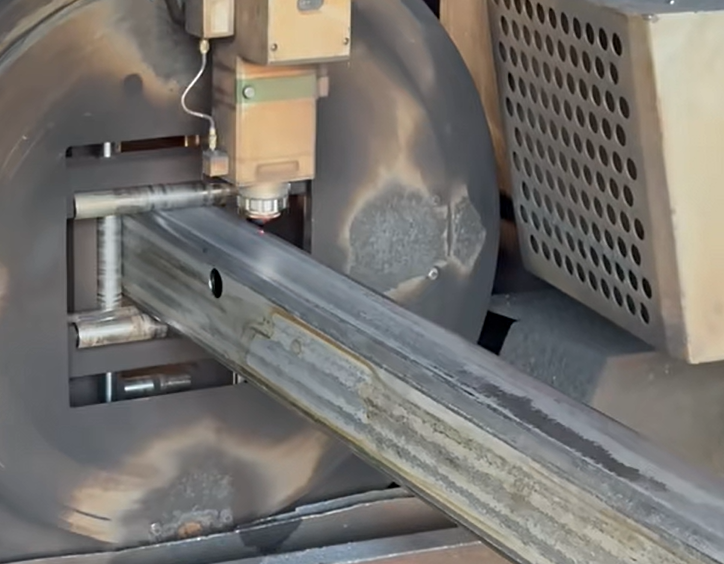
Qualified materials then enter CNC precision blanking:
• Pipes: cut to fixed length by automatic pipe cutting machines, with chamfering to avoid burrs.
• Plates: processed by laser/plasma cutting machines, ensuring consistent hole positions and edge smoothness.
This step lays the foundation for subsequent forming and assembly, minimizing dimensional deviations.
Cut components proceed to die-casting/stamping forming with unified tooling (fixtures):
• All parts (frame beams, side rails, mounting brackets) are formed using standardized molds and jigs.
• The unified tooling system guarantees:
a. Consistent shape and dimensional accuracy (tolerance within ±0.5mm)
b. Uniform hole positions and mounting interfaces for seamless assembly
c. Reduced manual adjustment and improved production efficiency
This process replaces traditional manual bending, ensuring every batch of trailers has identical structural dimensions, critical for large-scale production and after-sales replacement.
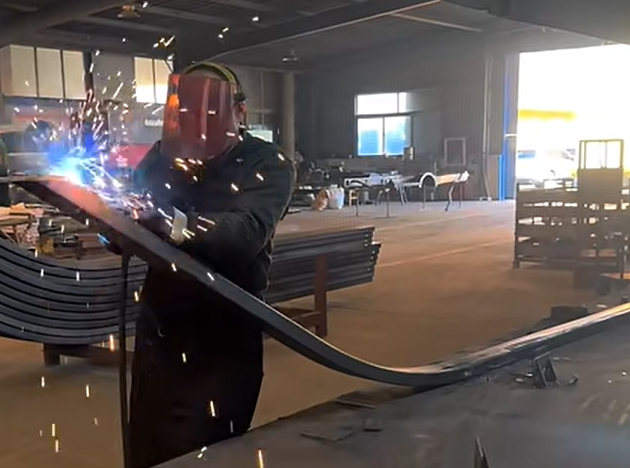
Formed components enter automated/submerged arc welding for frame assembly:
• Welders use CO₂ gas shielded welding or submerged arc welding, matching Q355B steel’s weldability.
• Key welds (frame joints, drawbeam connections) undergo 100% visual inspection and ultrasonic testing (UT) to detect internal defects (porosity, cracks, incomplete fusion).
• The entire frame is assembled on a fixed positioning platform, ensuring straightness and symmetry of the trailer structure.
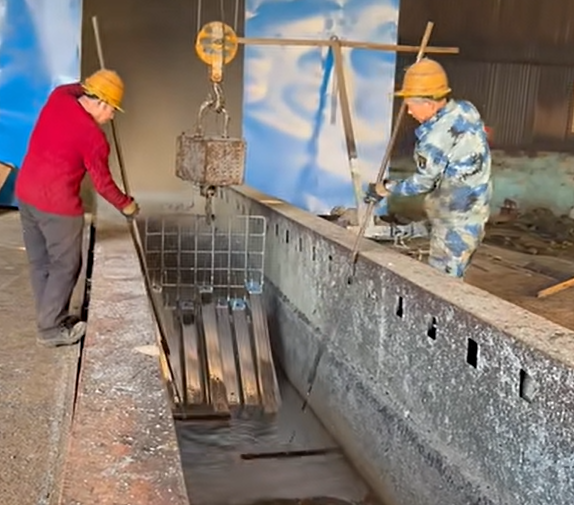
After welding, the semi-finished frame undergoes surface treatment for corrosion resistance:
1. Pickling & Derusting: The frame is immersed in a pickling solution to remove rust, oxide scale, and welding slag, creating a clean metal surface for zinc adhesion.
2. Flux Coating: A flux layer is applied to prevent re-oxidation before galvanizing.
3. Hot-Dip Galvanizing: The frame is fully immersed in molten zinc (450–460℃), forming a metallurgical bond between zinc and steel. The zinc layer thickness (typically 80–120μm) provides long-term protection against salt, moisture, and corrosion—far superior to paint or powder coating.
4. Water Cooling: After galvanizing, the frame is quickly cooled with water to stabilize the zinc coating, prevent thermal deformation, and ensure a smooth, uniform finish.
The final stage includes:
• Comprehensive quality inspection: Dimensional check, load test, corrosion resistance test (salt spray test), and functional test of the drawbeam and suspension.
• Packaging: The finished trailer is wrapped in protective film, with key components (drawbeam, wheels, lights) packaged separately in wooden crates or foam to avoid damage during ocean/land transportation.
• The drawbeam (trailer hitch assembly) is pre-assembled and labeled for easy on-site installation by end-users.
• Q355B Steel: High yield strength ensures the trailer can handle heavy loads (up to 1000kg+ payload) without deformation or cracking.
• Unified Tooling & Precision Welding: Consistent dimensions and high-quality welds eliminate structural weak points, meeting global trailer safety standards (e.g., ISO 3833 for road trailers).
• Hot-Dip Galvanizing: The zinc layer provides 10–15 years of rust protection in harsh environments (coastal areas, snowy regions, high humidity), far outlasting paint coatings.
• This reduces maintenance costs and extends the trailer’s service life, a key selling point for export markets.
• Unified Tooling: Standardized molds and jigs ensure every trailer is identical, reducing assembly errors and improving after-sales service (easy replacement of parts).
• Automated processes (CNC cutting, robotic welding) enable large-scale production while maintaining quality, suitable for bulk export orders.
4. Compliance & Export Readiness
• The entire process aligns with international quality management systems (ISO 9001) and trailer safety standards, making it easy to meet customs and regulatory requirements in North America, Europe, and other markets.
• Protective packaging ensures the trailer arrives intact after long-distance shipping, reducing after-sales complaints.
Conclusion
This standardized production process combines high-quality raw materials (Q355B steel), precision manufacturing, and industry-leading corrosion treatment, resulting in heavy-duty trailers that are safe, durable, and reliable. For export enterprises, these advantages directly translate to higher customer trust, lower maintenance costs, and stronger competitiveness in global markets.