Whatsapp
As cross-border trade in utility and hydraulic trailers surges between China and North America, one of the most commonly cited technical pain points for importers and fleet operators is electrical system compatibility between Chinese-built trailers and U.S. towing vehicles. For Chinese manufacturers targeting the U.S. market, understanding the nuanced differences between national wiring standards and simple low-cost adaptation solutions can eliminate costly delays at customs, avoid failed DMV registrations, and ensure seamless operation for end customers.
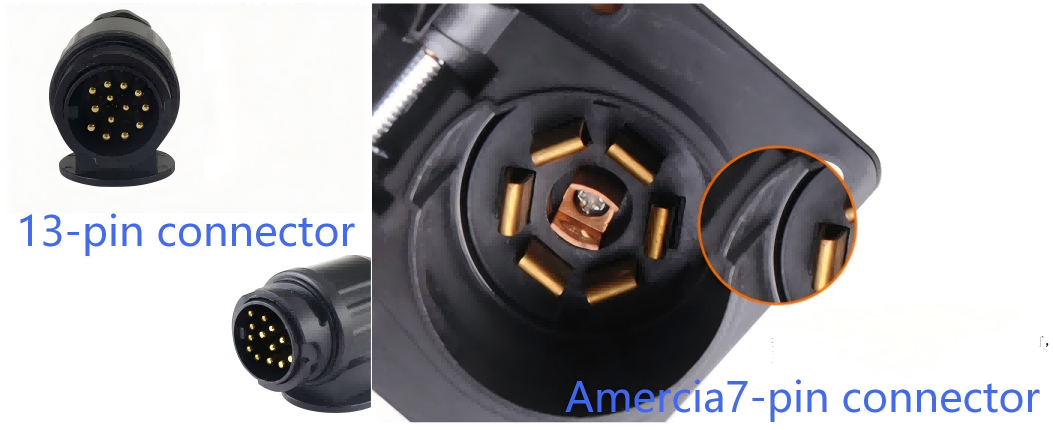
At the heart of the compatibility question are two distinct 7-pin trailer connector standards used in each market. China’s national standard GB/T 20716, first published in 2006 and updated in 2025, defines pin assignments for both 12V and 24V trailer electrical systems, with pin positions allocated to left turn signal, right turn signal, brake lights, tail lights, reverse lights, auxiliary power, and ground in a configuration optimized for domestic heavy truck fleets.
By contrast, the U.S. Society of Automotive Engineers (SAE) J2863 standard, adopted universally across North America for light and medium-duty trailers, uses a different pin mapping for the same 7-pin form factor. The most significant differences include swapped positions for brake light signals and auxiliary power, as well as alternative assignments for reverse lighting circuits, which can result in non-functional brakes, incorrect turn signal operation, or complete electrical failure if a trailer wired to the Chinese standard is plugged directly into a U.S. towing vehicle.
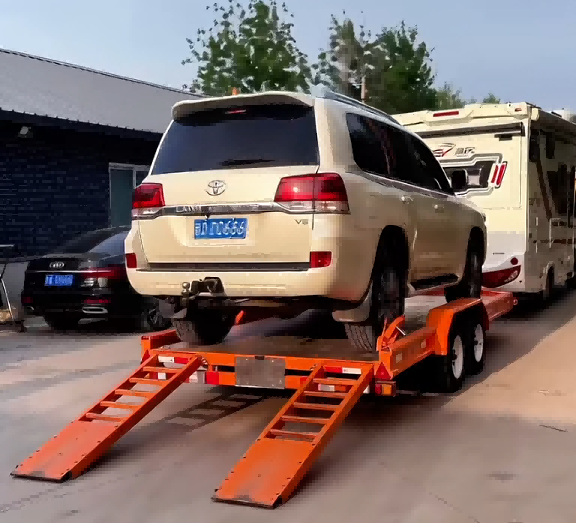
For 5-ton capacity hydraulic trailers like the GNT9010A model currently being prepared for U.S. export, this misalignment presents a negligible technical barrier, not a fundamental design flaw. The 12V electrical system used in most light and medium-duty Chinese export trailers is fully voltage-compatible with U.S. towing vehicles, requiring only pin resequencing to match SAE standards rather than complete system replacement.
Manufacturers have two straightforward paths to full compliance, both with minimal impact on production costs: 1. Factory pre-wiring to SAE standards: For dedicated export batches, adjusting the internal wiring sequence of the 7-pin connector during final assembly adds no material cost and less than 5 minutes of labor per unit. This produces a “plug-and-play” product that works immediately with all U.S. passenger trucks and commercial towing vehicles, eliminating the need for end-user modifications. 2. Aftermarket adapter cables: For mixed-production batches or units already in transit, off-the-shelf 7-pin cross-standard adapters are widely available at U.S. auto parts retailers for less than $20 per unit. These passive cables act as a translation layer between the Chinese pinout and U.S. towing vehicles, requiring no permanent modifications to the trailer itself.
Additional electrical adjustments required for U.S. DOT compliance are equally low-cost. U.S. regulations require all trailer lighting components to carry DOT certification markings, but compatible replacement LED and incandescent bulbs matching the same socket sizes used in Chinese trailer production are available for less than $1 per unit, with installation taking less than 10 minutes per trailer.
The 5-ton capacity GNT9010A hydraulic trailer, equipped with 4-wheel electric brakes, independent suspension, and a factory-specified American-style 7-pin connector, represents a model of pre-configured export readiness. Its 12V electrical system is fully compatible with U.S. vehicle voltages, and its 4-wheel electric brake system meets the U.S. federal requirement for all trailers over 3,000 lbs (1,360 kg) gross vehicle weight to have powered braking systems.
When pre-wired to SAE J2863 standards during production, the trailer requires only two additional minor adjustments to meet all U.S. road and registration requirements: application of DOT-compliant red-and-white reflective tape to the trailer sides and rear per FMVSS requirements, and inclusion of official VIN documentation with the unit for DMV registration. These adjustments add less than $30 per unit in material cost and 10 minutes of labor, making the trailer fully cost-competitive with U.S.-built equivalents while maintaining significant manufacturing cost advantages.
As U.S. demand for affordable, high-quality utility and hydraulic trailers continues to grow, electrical compatibility is a solvable challenge that should not deter manufacturers from entering the market. For exporters, the key to smooth market access is pre-emptive standard alignment during the design phase, rather than post-production retrofitting. Simple design choices including optional SAE wiring configurations, pre-installed DOT-certified lighting, and compliance with VIN assignment requirements can cut customs clearance times by up to 70% and eliminate post-delivery modification costs for importers.
For end customers in the U.S., the availability of competitively priced, pre-adapted Chinese hydraulic trailers is opening new opportunities for small business owners, construction operators, and recreational users who previously faced limited options in the mid-duty trailer segment. With proper attention to standard alignment and regulatory compliance, Chinese manufacturers are well positioned to capture a growing share of the $12 billion annual U.S. trailer market over the next five years.